Reimagining Title Operations in the US Mortgage Ecosystem


.jfif)

Imagine a title process where the moment a loan is initiated, a single system takes over. It connects with every major data source, pulls property and borrower information in seconds, evaluates title risk, generates commitments, coordinates closing, and completes funding and recording.
All of this happens with minimal human intervention.
That system does not yet exist as a standard across the industry. What does exist today is a collection of capable but disconnected point solutions, each addressing one part of the title lifecycle while leaving the seams between them to manual effort. The opportunity lies in closing those gaps.
A unified platform would bring together search providers, lender systems, notary networks, banks, and county records into a single connected ecosystem. Layered with AI, it automates decisioning and execution across the lifecycle, embedding human oversight at every regulatory touchpoint, to enable faster, more accurate, and operationally efficient title processing end to end.
At Firstsource, that is the direction we are building toward.
How the Current World Looks — And Where the Real Opportunities Lie
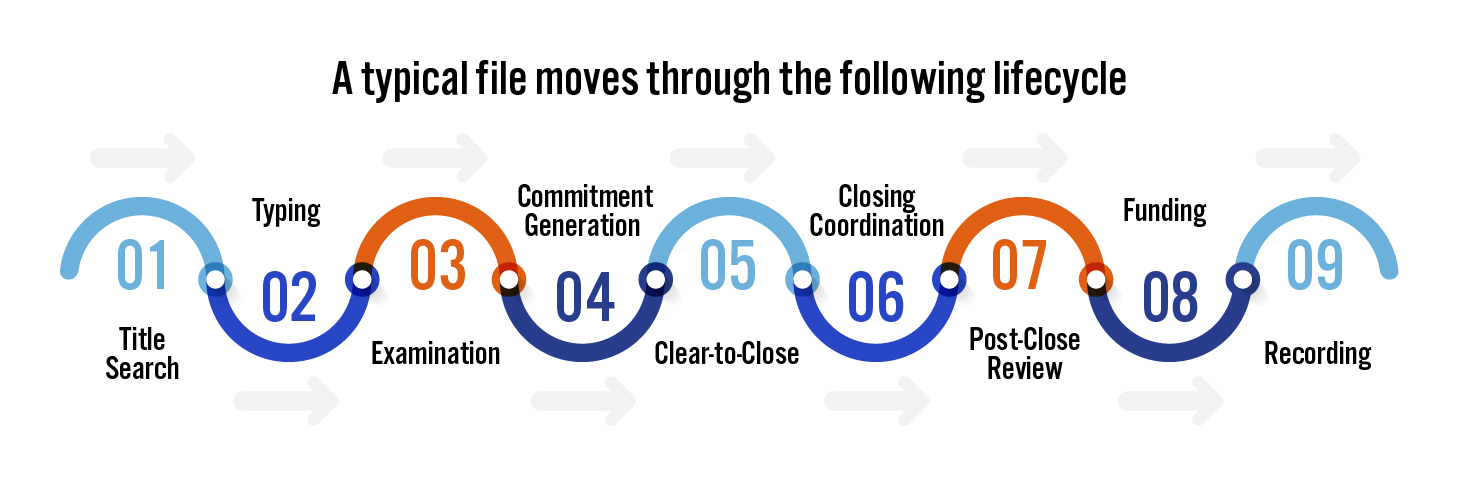
Today, even when individual steps are optimized, the overall process remains slow. The key friction points are:
- Manual Effort: High volumes of repetitive, human-driven data entry slow down every stage.
- Siloed Search Tools: Search tools operate independently, creating data fragmentation.
- Legacy Systems: Title production systems are closed environments with limited integration.
- No Automatic Data Flow: Data doesn’t flow automatically between systems, requiring constant manual handoffs.
The market is large, growing, and under pressure to modernise. The 30% of county records that remain undigitized represent a meaningful operational constraint, and it shapes the design of any realistic automation model.
Automation is possible. What remains to be solved is how to build for the gaps that still exist in the underlying data infrastructure.
Need for a Unified Platform: Fluid Data & Fixed Outcomes
The following sections outline a five-stage automation model that represents our structured view of where AI and deep system integrations could transform the end-to-end title lifecycle. The individual technologies referenced at each stage exist today as point solutions. The transformation lies in bringing them together into a single, coherent processing engine.
1. Order Intake and Automated Search
- LOS-Triggered Intake: The process would start automatically when a loan hits the processing stage in the Loan Origination System (LOS), eliminating manual order entry.
- Multi-Engine Search Integration: The platform would integrate with multiple “instant title” providers (e.g., Westcore’s X1 Express, Fluid) to query data plants and public records instantly with indemnification benefit.
- AI-Assisted Search for Counties Outside Instant Retrieval: For files that fail “instant” search, the platform would use AI (like First American, Dono AI) to perform automated online searches across all digitally accessible counties, leaving only the truly non-digital jurisdictions, a small fraction for manual abstractors.
2. Production and Examination
- GenAI Data Extraction: The system would use generative AI and logic-based prompts to “type” the report by extracting data directly from search packages, eliminating manual data entry.
- Automated Decisioning: An automated examination engine would identify potential title issues and determines if a file is “Clear to Close” (CTC) based on pre-set risk rules. All automated decisions must meet CFPB explainability requirements; human review of rejections is legally mandatory, not optional.
- Queue Elimination: By automating typing and examination (which usually take 45+ minutes of active work plus hours of “queue wait time”), the system could clear files in minutes.
3. Pre-Closing and CD Balancing
- AI-to-AI Collaboration: The platform’s AI would communicate directly with the lender’s system to balance fees and generate the Closing Disclosure (CD).
- Instant Document Packaging: Once balanced, the platform would merge lender and title documents into a digital package, ready for signing, without needing a manual “stacking order.”
4. Digital Closing (e-Closing)
- Automated Notary Dispatch: The system would detect lender readiness and automatically notify a digital notary panel, with the interested notary party picking up the order.
- RON and Face-to-Face Video: Remote Online Notarization (RON) would enable the borrower, title company, and notary to meet via a three-way video call. In 2025, ~22% of lenders used eNotes, with growing interest in RON eClosings.
- “Error-Free” Signatures: The system would prevent incomplete filings by using DocuSign-like cues to ensure all necessary signatures and dates are present before a closing can conclude.
5. Post-Closing, Funding, and Recording
- Real-Time Post-Close Review: For physical closings, “fax-back” documents would be instantly reviewed by AI. If a signature is missing, the system would notify the notary.
- Integrated Funding: The platform would integrate with the banking system to detect incoming lender funds and automatically generate wires/payouts, requiring only an approval by an independent team ensuring segregation of duties.
- e-Recording and Policy Issuance: Signed documents would be automatically transmitted to e-recording services like Simplifile. Once recorded, the system applies state and property rules to instantly issue the final Title Policy.
What Straight-Through Processing Would Actually Change
The five stages above are not a roadmap for incremental improvement. They describe a structural shift in how title operations run: from a process built around human handoffs to one designed for automated flow, with humans intervening only where judgment or approval is genuinely needed.
The operational benefits are significant. Manual data re-keying, report typing, fee-balancing cycles, document stacking, and post-close error chasing are among the most time-consuming and error-prone activities in the current model.
A straight-through processing engine designed around the five stages previously described would address each of these directly, not by optimizing the steps in isolation, but by removing the friction between them.
The underlying data infrastructure is not yet uniform across all counties, and full automation will remain out of reach in some jurisdictions for the foreseeable future. But the proportion of files that could move from loan initiation to recorded policy with minimal human intervention is already large enough to represent a meaningful operational opportunity.
As digitization continues and AI capabilities mature, that proportion will grow. The organizations building toward this model now will be better placed to absorb volume, reduce cycle times, and improve accuracy.