
Beyond the Course Container: Turning Existing Curriculum Into Applied Learning Sprints

Key Takeaways
- Traditional course structures manage cognitive load well, but they often leave a "transfer gap" between what students know and what they can do on the job.
- An in-house AI engine converts existing lecture decks, PDFs, and syllabi into competency-based learning sprints with realistic simulations and gated assessment.
- Faculty approve, edit, or reject every AI-generated item before it reaches students, and each item traces back to its source document.
- Students move from Guided to Practice to Exam mode, while faculty get cohort analytics on progress, efficacy, and struggle signals, plus competency data for accreditation.
For decades, higher education curriculum has been organized around a content-centric model: disciplines divided into courses, modules, and lessons. This linear structure manages cognitive load well, but it can also create a disconnect between theoretical knowledge and practical application.
In parallel, many workplaces have shifted toward agile, project-based ways of working. Professional teams often collaborate in short project sprints, solve problems across disciplines, and iterate on real-time feedback. This has created a "transfer gap": traditional instruction builds strong domain knowledge but often falls short of preparing students to apply it in these settings. Whether delivered through an LMS or a course-based curriculum, the linear module-and-lesson model remains the institutional default.
This brief outlines a modern, transformative approach to instructional delivery.
By using an in-house-developed AI engine, institutions can re-architect their existing academic content into interactive, sprint-based learning experiences. This approach helps bridge the gap between theory and practice, supports academic accountability, and generates accreditation-ready data, while reducing the administrative load on faculty.
1. The Pedagogical Disconnect: The Content vs. Context Dilemma
So why does higher education still organize learning this way?
For the most part, traditional, linear content structures excel at managing cognitive load and building initial schemas.
However, they often fail to bridge the “transfer gap” to the modern workplace, where work happens not through isolated learning objectives, but through multi-disciplinary project sprints. A 2015 survey by 24x7 Learning, cited in Harvard Business Review, found that only about 12% of employees said they apply what they learn in formal training on the job.
To maximize performance readiness, contemporary learning science favors situated cognition and task-centered instructional frameworks, such as David Merrill’s First Principles of Instruction and Jeroen van Merriënboer’s 4C/ID model. These frameworks hold that rather than learning a skill in a vacuum, students should practice in settings that reflect the authentic task environment.
Organizing learning into project-based or simulation sprints mirrors the workflow, collaboration, and problem-solving students will face on the job. Some learning-technology providers report retention gains of up to 75% from simulation-based practice. The broader research evidence for active learning is also strong: a meta-analysis of 225 undergraduate STEM studies found failure rates of 21.8% under active learning versus 33.8% under traditional lecturing.
2. Demographic Imperatives: Microlearning & Active Engagement
Compounding this shift away from rigid course structures is the fact that a "one-size-fits-all" delivery model fails modern workforce demographics.
Younger generations like Gen Z have developed highly efficient information-filtering habits, often deciding within seconds whether the content is worth their attention. As a result, instructional architecture should shift toward microlearning assets. This requires breaking dense textbooks, lecture notes, and lengthy video monoliths down into digestible lesson cards, contextual examples, and scenario-based simulations optimized for responsive cross-device access (desktop, laptop, and mobile phones).
Furthermore, modern instructional design favors active learning frameworks over passive consumption. Rather than scrolling through static documents, learners retain more when they engage with interactive checkpoints, gamified quizzes, and branching scenarios. A modular, multimodal layout transforms the educational experience from an administrative hurdle into an agile, engaging toolkit that learners can actively pull from at their exact point of need in the workplace.
3. The Paradigm Shift: Traditional Curriculum vs. Modern Sprint Layout
To operationalize this shift, higher education leadership must transition from a content-first mindset to a context-first framework. This evolution does not compromise academic rigor; instead, it untethers valuable faculty knowledge from rigid structures and repackages it into dynamic, work-ready delivery formats.
.png)
Transitioning to this modern framework does not require faculty to rewrite their domain expertise from scratch. Instead, it re-architects existing textbooks, lecture notes, and case studies into an interactive, active-learning ecosystem. By organizing knowledge around real-world application, institutions can better prepare graduates not just to "know" the subject, but to apply it in cross-functional teams from day one.
4. The Solution: An AI-First, Compentecy-Based Instructional & Learning Ecosystem
The Catalyst: Achieving Scale, Speed, and Competency Level Personalization Through GenAI
Re-architecting thousands of course pages into interactive, mobile-friendly micro-sprints traditionally required large instructional design teams and months of manual work. It simply did not scale.
To close this operational gap, our in-house-developed platform functions as an AI-first, competency-based instructional and learning ecosystem. It unites the faculty teaching workflow and the student mastery journey in a single, cohesive framework. By flipping the traditional academic constraint, so that time becomes the variable and mastery the constant, theplatform organizes education into Competency Units (CUs) driven by adual-facing, four-pillar GenAI engine:
• Intelligent Content Deconstruction (Faculty-Facing): The AI engine ingests departmental assets such as lecture decks, PDFs, and syllabi, and breaks long-form text into bite-sized lesson cards and micro-scenarios mapped to specific competency frameworks for faculty editorial review.
• Realistic Practice via Simulated Environments (Student-Facing): Students rehearse workflows through multi-turn, conversational simulations with an interactive AI Stakeholder (e.g., patient intake, client brief, or audit target) while working in simulated versions of real-world digital tool configurations.
• Programmatic, Gated Assessment (Dual-Facing): Progression through a sprint is gated. Students must complete prerequisite checkpoints before advanced practical simulations unlock, giving faculty confidence that no student skips foundational knowledge.
• Accreditation-Ready Rubrics (Dual-Facing): Faculty set custom competency pillars and weights tailored to professional standards. The system supports non-negotiable auto-fail compliance rules: if a student misses a critical safety or ethical threshold, they fail that simulation attempt regardless of their scores on other pillars. This preserves programmatic integrity while giving students clear parameters for mastery.
5. The Scaffolded Progression Pipeline & Quality Gates
To ensure complete compliance with academic standards and protect institutional integrity, content transformation follows a strict, hallucination-free development pipeline:
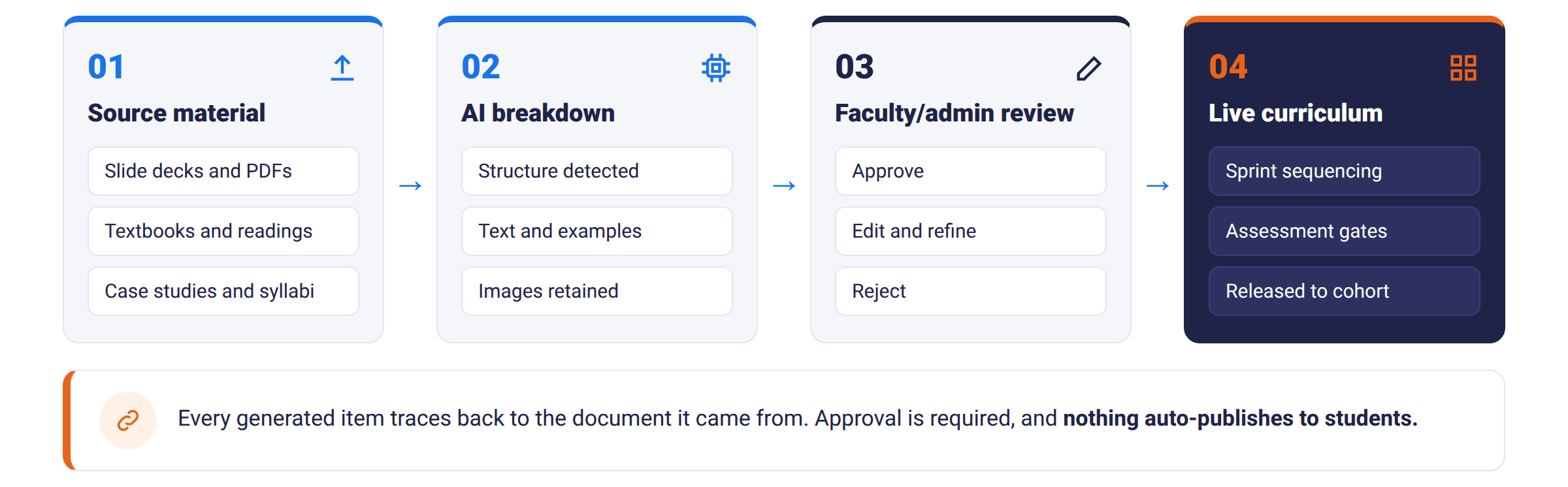
1. Source Material: Faculty upload their raw instructional resources (Slide decks, textbooks, case studies, or process guides).
2. AI Breakdown: The engine detects structural logic, extracts text blocks, maps relevant examples, and retains vital instructional illustrations.
3. Faculty/Admin Review (The Quality Gate): Content never auto-publishes to a student dashboard. Academic admins and faculty utilize a dedicated interface to seamlessly Approve, Edit and Refine, or Reject any AI-generated micro-asset.
4. Live Curriculum: Approved blocks are instantly compiled into the sequenced sprint, anchored behind knowledge gates, and deployed to student cohorts. Every micro-card or scenario maintains source traceability, linking directly back to the source document.
Scaffolding to Independence
Once live, the platform deploys the same simulation asset across three progressive execution modes to move the learner from structured support to unassisted competency evaluation:
• Guided Mode: High-support delivery featuring active on-screen instructions, hints, and structural guardrails.
• Practice Mode: Medium-support delivery. Guardrails are removed, but optional hints remain accessible, with comprehensive feedback provided immediately after completion.
• Exam Mode: High-stakes summative mastery. No external support or hints are provided, and unassisted competency data is captured for programmatic accreditation.
6. Purpose-Built Experiences & Metacognitive Analytics
Our platform provides three purpose-built surfaces engineered specifically for the distinct workflows within a higher-ed institute ecosystem:
• The Developer Surface (Instructional Designers & Admin): Provides full structural control over core content generation and automated exam creation to ensure administrative consistency across sections.
• The Learner Surface (Students): A seamless, responsive interface optimized for mobile and desktop views where students act as the primary users of lesson cards, conversational AI roleplays, and workflow simulators.
• The Mentor Surface (Faculty ): Explicitly optimized for faculty time efficiency. Instead of configuring layouts, faculty monitor an integrated analytics engine that tracks student behavior across three distinct, macro-cohort dimensions:
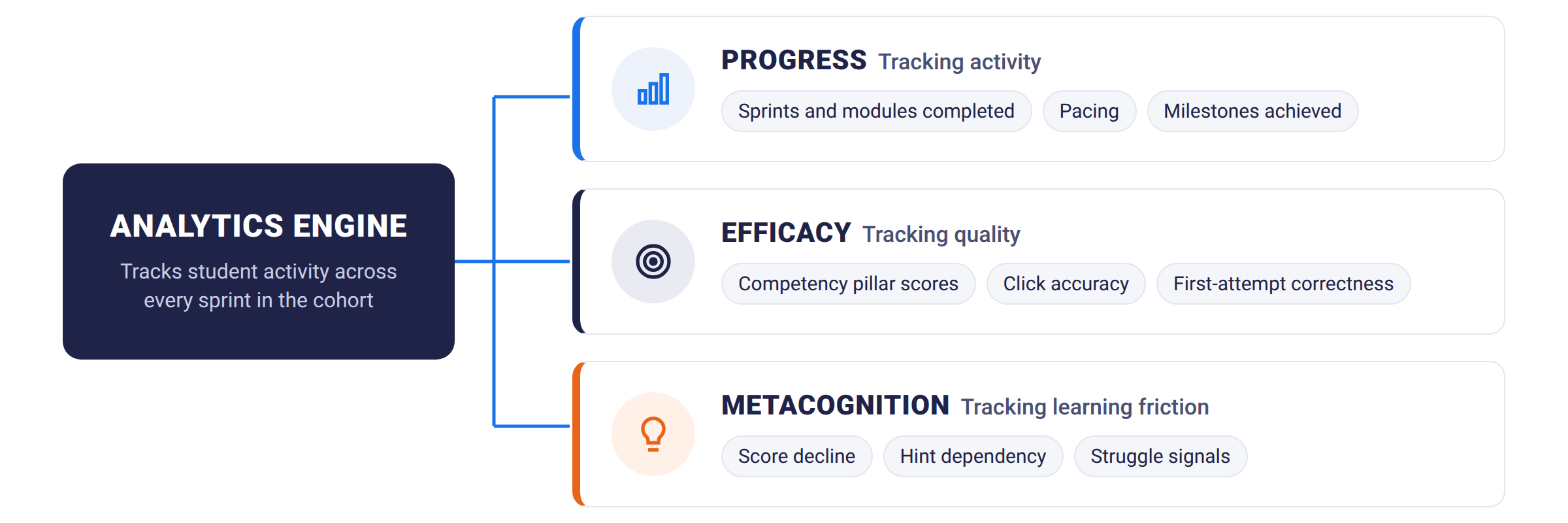
1. Progress (Tracking Activity): Audits mechanical completion rates, active pacing, and module milestones achieved across the current cohort.
2. Efficacy (Tracking Quality): Aggregates capability performance across custom competency rubric pillars, logging precise click accuracy and first-attempt correctness metrics to measure tactical precision.
3. Metacognition (Tracking Learning Friction): Uncovers how a student is processing problems by tracking score decline over time, logging hint dependency rates, and identifying behavioral struggle signals. This allows faculty to provide targeted, timely support interventions before a student drops out.
7. Empowering Faculty, Advancing Deans & Program Directors
Preserving Academic Rigor, Reducing Administrative Friction
Our platform facilitates modernizing the content development cycle by allowing faculty members to be who they actually are: Subject Matter Experts, and not getting caught in the administrative tasks of content production. Faculty retain complete editorial control and pedagogical oversight, while the AI manages the structural heavy lifting.
The result is a transformative institutional asset:
• For Deans & Program Directors: A value proposition for enrollment, demonstrating measurable career-readiness, competency tracking, and clear alignment with employer demands.
• For Faculty: Deep analytics into measuring student success, allowing for targeted, timely interventions rather than repetitive lecturing.
• For Students: An immersive, flexible learning experience that mirrors the digital tools and fast-paced environments of their future careers.
8. The Strategic Next Step
From Linear Courses to Learning Ecosystems
Over my 30 years in instructional design and EdTech consulting, I’ve seen many trends come and go. What we’re seeing now feels different. It’s less a passing trend and more a fundamental shift in how learning is designed, developed, and delivered, shaped by broader changes intechnology, economics, and the way people learn and work.
The traditional linear approach to course development is gradually giving way to more context-driven, AI-enabled learning ecosystems,where content can evolve more dynamically around the learner, the moment, and the need. Whether you’re just beginning to explore this shift or have already started your journey, we’d be happy to share what we’re learning along the way.
Reach out to us to explore how institutions are navigating thechallenges of moving from traditional content production toward more modern, agile, sprint-based learning ecosystems.

%20Thumbnail%20Images/Article2_408x213.png?updatedAt=1792078849371&tr=w-412,h-232,c-maintain_ratio,q-80)
%20Thumbnail%20Images/Article1_408x213.png?updatedAt=1792078849256&tr=w-412,h-232,c-maintain_ratio,q-80)