How AI can be a Secret Weapon in the Fight Against Financial Difficulty


UK banks no longer have to wait for a missed payment before stepping in to support a vulnerable customer.
AI systems can now read the early signals of financial difficulty in a customer's transaction data and open a no-judgement conversation before arrears ever appear, turning vulnerability support from reactive to proactive.
For those charged with helping the millions of UK households that are attempting to manage debt, leveraging AI solutions will become an invaluable tool in the fight against financial hardship…
One in three people in the UK face financial difficulty
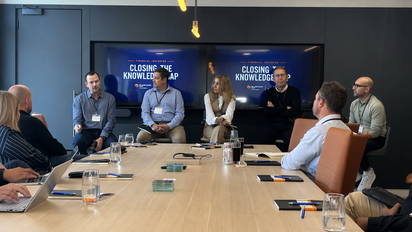
Attendees at the UK Finance ‘Helping Customers in Financial Difficulty Conference 2026’ heard how mortgage arrears sit at roughly 80,000 accounts - about 1% of the market, the lowest since 2023. That headline flatters. It measures damage already done, not damage building due to rising interest rates and stagnating wage growth.
Interest rates are rising faster than forecast. Several hikes are anticipated in the next 12 months. Millions of mortgage holders locked in at historic-low fixed rates face payment jumps of hundreds of pounds a month when those deals expire.
Wage growth has slowed from roughly 6% in early 2024 to around 3% today, and job losses are building among younger, lower-paid workers in retail, hospitality and the gig economy - the under-35 cohort with the thinnest savings.
The scale is stark. Research presented at a recent UK Finance conference found 19.4 million people across the UK are in active financial difficulty or at immediate risk. Around 10 million people are borrowing for everyday essentials, while 15 million can’t cover a small unexpected bill even by borrowing.
As one industry expert at the UK Finance conference put it, "it is those with the thinnest buffers who carry the most risk."
And the dominant arrears aren't in mortgages or credit cards. They're in utilities, council tax and phone bills - the last things households cut before they seek help. Growing utility arrears signal genuine desperation, not short-term cash-flow mismanagement.
For any bank or building society board, this is a convergence of regulatory, reputational and balance-sheet risk. UK Consumer Duty demands that firms identify and support vulnerable customers. Exposure grows as interest rate rises work through household finances.
Why existing responses fall short
Banks have invested in late-payment processes, vulnerability teams and trained contact-centre staff. However, there is often a gap between available support and those who need most. There are two reasons for this:
Stigma. Financial difficulty carries shame. People delay reaching out not necessarily because they don't know support exists, but because admitting the problem means confronting something they've been taught to hide. By the time someone contacts their bank, the issue has often grown from manageable to crisis.
A knowledge gap. Many customers don't understand what benefits they're entitled to or what their bank can offer. Some lenders are building income-maximisation tools so affected households can see their full entitlements - a powerful way to meet customers where the problem is most acute. But these tools only help people who engage. And engagement is exactly what stigma blocks.
Predictive AI: Seeing vulnerability before the call
This is where the investment decision sharpens. Tabular Foundation Models (TFMs) - AI systems trained on billions of transactions - can build predictive profiles of what customers look like at different stages of financial health. Early signals of vulnerability show up in transaction data long before they appear in arrears reports: shifts in spending patterns, growing reliance on credit for essentials, tightening cash flow.
These models flag customers entering a vulnerable state in real time, giving lenders the chance to reach out proactively with support, guidance or hardship options before the customer has to ask. Prevention, not just crisis management is what makes a real difference.
Conversational AI: Removing the shame barrier
Predictive identification is only half the picture. The other half is how you engage customers once flagged.
Modern conversational AI opens doors customers might otherwise keep closed. On sensitive topics like debt, many customers prefer a non-judgemental AI agent. Natural language processing now understands rambling, emotional explanations - not just keywords - capturing the full picture of a customer's situation.
Three advantages matter at board level:
• Capacity allocation. AI handles high-volume queries, freeing human agents for complex, emotionally demanding conversations where judgement and empathy are non-negotiable.
• Rich handover. AI summarises a customer's situation accurately and contextually, so when a conversation escalates to a human specialist, the customer tells their story once - not multiple times.
• Next-best-step recommendations. AI surfaces options drawn from patterns of successful outcomes, which human agents then refine and personalise.
As one of the UK Finance conference panelists noted: “Whatever you're doing, it needs to replicate the journey delivered by your human agents." The goal is augmentation, not automation for its own sake.
Another panelist, who represented an enterprise voice AI organisation, went on to claim that in bereavement support - among the most sensitive banking interactions - some institutions are seeing CSAT scores 50% higher with AI agents than with humans, because AI delivers consistency, patience, and no time pressure at scale.
What separates leaders from laggards
Three lenders facing the same stressed customer share the same regulatory playbook. What separates a leading response from a laggard one is the ability to reach the customer early, understand their situation with nuance, and deliver personalised support at scale. That's the capability gap AI closes.
The institutions that invest now in predictive detection and low-judgement engagement will carry less risk as conditions worsen. Those that wait will face higher arrears, higher cost-to-serve and harder regulatory conversations.
Shift vulnerability detection from reactive to proactive. Choose partners who build AI that enhances human expertise rather than replacing it. And start now - before the next wave of financial difficulty hits your book.