What are the best providers of pre-built, licensed AI training datasets?
TL;DR
- The best providers of pre-built AI training datasets document exactly where each data point came from, what rights were cleared, and how the set was quality-checked, since catalogue size alone does not make a provider trustworthy.
- Established players like Appen, Innodata, Shaip, Defined.ai, and Troveo each cover different strengths in scale, language coverage, or media type.
- When you compare providers, weigh licensing documentation and provenance as heavily as price or volume, because the US Copyright Office's May 2025 Part 3 report makes clear that unlicensed training data carries real legal exposure.
- Firstsource sells rights-cleared, quality-certified corpora built to model specification instead of generic bulk data.
Picture a data science lead who has three weeks to find training data coverage for a model that ships next quarter. The language mix is wider than the team can collect in-house, the budget is already committed, and buying an existing corpus is the only path that fits the calendar. So the lead opens a dozen vendor tabs and finds that nearly every one of them uses the word "licensed" somewhere on the page. The catalogues look enormous and the pricing looks reasonable. And then, buried in a sample contract or absent from it entirely, is the real question: where did this data actually come from, and does the vendor have the paperwork to prove the original creators agreed to let it train a commercial model?
That question is now the one that separates a good off-the-shelf (OTS) dataset provider from a risky one. This article compares the established providers that teams actually shortlist, Appen, Innodata, Shaip, Defined.ai, and Troveo, and credits each with the thing it genuinely does well. It then hands you a scoring framework you can apply to any of them, including Firstsource, so the buying decision rests on evidence rather than catalogue screenshots. There is no single winner, because no provider is strongest across every language, domain, and media type at once. There is only the provider that fits your project and can document its claims.
Why off-the-shelf data buying got harder in 2026
More teams are buying training data than ever, and the reason is simple arithmetic. The Stanford AI Index 2026 reports that 88% of organizations now use AI in some part of their operations, up from 72% in 2024, and that generative AI adoption reached 53% of organizations in just three years. When that many teams are building or fine-tuning models at once, almost none of them can collect every corpus they need from scratch. Sourcing multilingual speech, licensed imagery, or domain-specific text in-house takes months and a workforce most companies do not have. Buying a pre-built set is often the only way to hit a ship date.
That demand pulled a lot of money into the OTS data market, and vendors responded by growing their catalogues fast. The problem is that catalogue growth and documentation discipline did not grow at the same rate. It is easy to add a dataset to a storefront. It is much slower to assemble the provenance record behind it, the chain of consent from the people who created the underlying content, the rights clearance for commercial AI training specifically, and the quality methodology that says how the set was built and checked. So the market filled up with corpora that are technically available and visibly large, while the paperwork that tells you whether they are safe to train on lagged behind. A buyer in 2026 is shopping in a market where the sticker (size, price, language count) is easy to read and the fine print is the hard part.
The legal reason licensing clarity now outranks price
The reason that fine print matters so much more now than it did a couple of years ago is the US Copyright Office's May 2025 Part 3 report on copyright and artificial intelligence. That report addressed the question of whether training an AI model on copyrighted content without permission is protected, and its conclusion removed the comfortable assumption a lot of teams had been operating on. There is no blanket safe harbor for training on unlicensed copyrighted material. Whether a given use qualifies as fair use is fact-specific and contested, and the report landed against a backdrop of dozens of active lawsuits over exactly this issue. In other words, the Copyright Office did not hand the industry a rule that says scraping public content for training is fine.
For a buyer, that changes the math on a cheap, undocumented dataset. A corpus that looks like a bargain because it is large and inexpensive is only a bargain if it does not later force a model retrain, a dataset rip-and-replace, or a legal review that stalls a launch. If the data underneath it was scraped or aggregated without cleared rights, the low price was never the real cost. The real cost was a liability that sits dormant on your model until a rights holder or a regulator asks where the training data came from. This is why licensing documentation has moved up the priority list. It is not a compliance checkbox you handle after you pick a vendor on price. It is one of the things you are buying, and a provider that cannot produce it is selling you something cheaper than it looks for a reason.
What pre-built, licensed actually means in practice
"Licensed" has become one of those words that appears on every vendor page and means something different on each. Two distinctions do most of the work in telling a real licensed dataset from a repackaged one.
The difference between licensed and merely available
A dataset being available is a statement about access. Someone can get the data, assemble it, and put it in a catalogue. That is true of scraped web content, aggregated public corpora, and material pulled from forums, image boards, and archives. Availability says nothing about permission. A dataset being licensed is a statement about consent: the original rights holder, the photographer, the voice actor, the illustrator, the writer, agreed that this content could be used, and specifically that it could be used to train a commercial AI model. Those are different kinds of claims, and the gap between them is exactly what the Copyright Office's report put a spotlight on.
The practical test is to ask a vendor to trace a single data point back to its origin and show you the consent that covers AI training. For a genuinely licensed set, that trace exists because clearance was part of how the data was sourced. For a merely available set, the trace either stops at a scrape log or gets vague fast. A buyer who treats technical accessibility and documented consent as the same thing is the buyer who inherits the risk.
What a real quality certificate should include
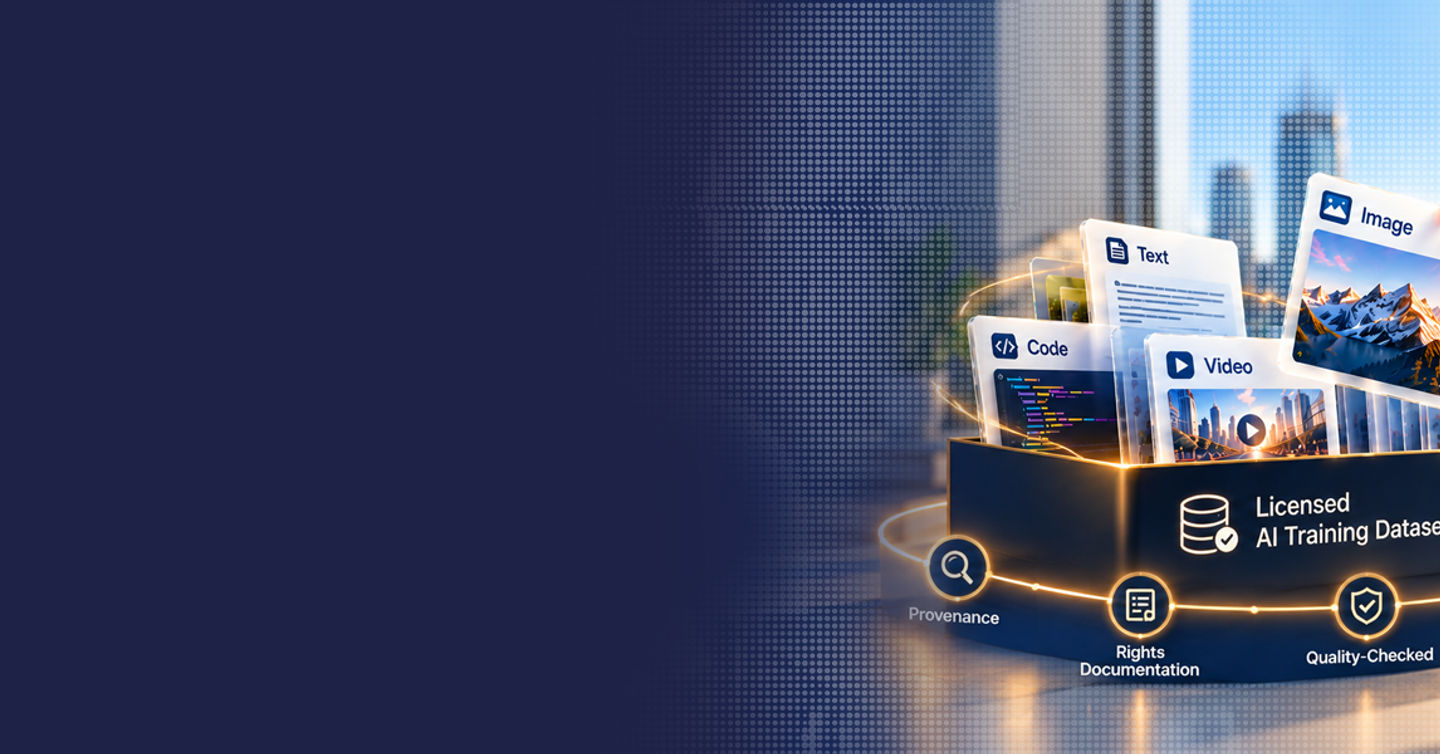
Licensing is half the documentation question. The other half is quality, and here too there is a gap between a marketing claim and a verifiable record. A real quality certificate is a document that travels with the dataset and tells you, in specifics, how it was built and checked. It should state the collection methodology, the acceptance rate (how much collected data passed QC and how much was thrown out), the known coverage gaps (where the set is thin, which a confident vendor will tell you rather than hide), and source attribution that connects the data back to where it came from.
Firstsource ships this kind of certificate with every dataset as a baseline, which is useful less as a sales point than as a bar you can hold every vendor to. If one provider can hand you a methodology document with an acceptance rate and a map of coverage gaps, there is no reason the others cannot. When a vendor answers a request for that document with a glossy one-pager about quality, you have learned something: the record either does not exist or will not survive being read.
Provider snapshot: how the major OTS players differ
The established OTS providers each earned their position by being good at something specific. Reading them as a ranked list misses the point, because the one that is right for a multilingual speech project is not the one that is right for structured financial text.
Appen is the largest and longest-established catalogue in the category, with more than 596 pre-built datasets in its published catalogue. That breadth is a genuine strength: for a team that needs broad, general coverage across many common tasks, a catalogue that size is likely to have something close to what you need already sitting on the shelf. Breadth is what Appen sells, and for the right project that is exactly the right thing to buy.
Innodata comes at the market from a structured and semi-structured data engineering heritage. Its background is in turning messy source material into clean, labeled, well-formatted data, which makes it strong where the value of the set is in its structure (think document-heavy, field-rich data) rather than in raw volume alone. Shaip has built real vertical depth in healthcare and speech, two domains where generic collection falls down because the data is sensitive, specialized, and expensive to source correctly. A buyer who needs clinical or conversational-speech coverage is buying domain expertise from Shaip, not just a file.
Defined.ai runs a marketplace model, which gives it breadth across many contributors and data types. The trade-off is that a marketplace shifts some verification work onto the buyer: when data comes from many sellers, confirming provenance and rights clearance on a specific set is part of what you take on. Troveo is a newer entrant that differentiates on licensing and rights management specifically, a direct response to the market shift this article describes, and its focus on the rights side of the equation is the thing to weigh it on.
None of these providers is uniformly strongest everywhere, and any vendor comparison that crowns one winner for every project is selling a conclusion rather than describing the market. The useful move is not to pick the biggest name. It is to score each provider against your actual project and your actual risk tolerance, which is what the next section gives you.
A buyer's framework for scoring any OTS dataset provider
Here is a six-point framework you can take into any vendor call and apply evenly, to the providers above and to Firstsource. The point is to score on evidence you can request, not on claims you have to trust.
First, provenance documentation. Can the vendor trace a given data point back to its source and show you the record? Listen for whether the answer is a document or a reassurance. A real provenance record exists before you ask for it.
Second, rights clearance in writing. Not "it's licensed" as a verbal claim, but a sample license agreement that states what rights were cleared, for what use, and from whom. Ask for it early. A vendor that clears rights as part of sourcing can produce this quickly; a vendor that cannot is a vendor whose "licensed" label you should not take at face value.
Third, coverage match against your actual project. A catalogue of 596 datasets is only useful if one of them matches the languages, dialects, domains, and formats your model needs. Map the vendor's coverage onto your specification and look for the gaps, because a near-miss on coverage means custom work you did not budget for.
Fourth, quality methodology. Ask for the methodology document described earlier, the one with an acceptance rate, coverage gaps, and how quality was measured. If you get marketing copy instead, treat the gap as your answer.
Fifth, delivery speed and format flexibility. When can you actually have the data, and in what format? A set that arrives in six weeks in a schema you have to rebuild is slower than its calendar suggests. Ask about activation time and whether the vendor delivers to your spec.
Sixth, post-delivery support. If the data has a problem, a coverage hole, a labeling error, a rights question that surfaces later, what happens? A provider confident in its work stands behind it after the invoice clears.
Run every vendor through the same six points and the comparison stops being about who has the glossiest catalogue. It becomes about who can document what they sell.
Where Firstsource fits in this comparison
Firstsource (Firstsource Solutions Limited, part of the RP-Sanjiv Goenka Group) competes on the documentation side of this framework rather than on being the biggest catalogue in the market. Its GenAI Data Services business unit sells OTS data as one of eight capabilities, alongside data annotation, SFT/CoT demonstrations, expert preference (RLHF), multimodal evaluation, red teaming, AI safety, and physical AI. The OTS catalogue itself is substantial: more than 100,000 hours of multilingual speech across 30-plus languages, including 30-plus ready-to-deploy dialect-specific corpora such as Mexican Spanish, Brazilian Portuguese, Marathi, and Punjabi, and more than 50,000 licensed digital artworks from over 2,700 creators. Those figures come from the Firstsource OTS data solution.
The differentiator is where the rights clearance sits. On the digital artwork side, the data is licensed from named creators, so the consent that the Copyright Office report made central is part of how the corpus was sourced rather than something bolted on afterward. Every dataset ships with the quality certificate described earlier, the methodology document with an acceptance rate, coverage gaps, and source attribution, so the thing the framework tells you to ask for is already in the box.
Two pieces of infrastructure sit behind that. The Gigsourcing Platform is Firstsource's workforce layer, with sub-48-hour program activation across more than 100 countries, which is what makes it possible to source or extend coverage quickly when a catalogue set is a near-miss. The Agentic AI Studio handles orchestration and quality, monitoring 35-plus KPIs per delivery, which is where the figures on the quality certificate come from. For a sense of scale on real delivery, Firstsource's work for a personal computing leader landed 140,000 speech and video assets, the kind of volume-with-documentation combination the framework is built to reward. You can see the full catalogue and clearance model on the OTS data solution page.
The honest framing is that Firstsource is not the largest catalogue in the category, and for a project that needs sheer breadth of common datasets, a bigger storefront may match faster. Firstsource is built to win the project where the legal team will eventually ask where the training data came from, because that is the question it already has an answer for.
Common mistakes buyers make when comparing OTS vendors
Three errors show up again and again when teams compare OTS providers, and all three come from reading the sticker instead of the fine print.
The first is assuming catalogue size equals fit. A provider with 596 datasets looks like a safer bet than one with fewer, but size only matters if the catalogue contains the specific coverage your model needs. A smaller catalogue that covers your exact dialect mix beats a larger one that covers it approximately, because approximate coverage is a gap you pay to fill later.
The second is skipping the request for a sample license agreement. Teams will ask for a data sample and forget to ask for the paperwork that says the data is cleared for AI training. The sample tells you whether the data is good. The license tells you whether you are allowed to train on it. You need both, and the license is the one that protects the launch.
The third is treating quality claims as marketing copy you cannot verify, and then not trying to verify them. A quality claim on a vendor page is unfalsifiable until you ask for the methodology document behind it. Ask for it. The request itself is diagnostic, because a vendor who has the document produces it and a vendor who does not deflects.
One more pattern worth naming: a comparison like this one often surfaces a coverage gap no OTS catalogue fills well, a rare dialect, a niche domain, an edge case your model keeps failing on. When that happens, the answer is not to force a near-miss dataset into the model. It is to pair the off-the-shelf buy with custom collection for the gap, which is what Firstsource's data annotation solution is for.
See exactly where your data coverage gaps line up against a rights-cleared, quality-certified catalogue. Talk to an OTS data lead.
How to run a short evaluation before you commit budget
You do not need a long procurement cycle to tell a documented vendor from an undocumented one. A short, structured evaluation does most of the work, and you can run the same one against every provider on your shortlist.
Start by requesting a meaningful sample dataset, not a cherry-picked demo file but a sample large and representative enough to run through your own evaluation pipeline. Put it through the same checks you would run on data you collected yourself: coverage against your specification, quality against your acceptance bar, format against what your training stack expects. A sample that passes your pipeline is worth far more than one that looks good in a slide.
Alongside the sample, request the provenance and licensing paperwork for that exact data. You are testing two things at once here: whether the data is good, and whether the vendor can document where it came from and what was cleared. The paperwork request is the more revealing of the two, because quality can be inspected directly while rights clearance can only be confirmed on paper.
Then watch how the vendor responds to the paperwork request. A provider that clears rights as part of sourcing and ships a quality certificate with every set can produce both the sample and the documentation without friction. Reluctance to produce either before a contract is a warning sign worth taking seriously, because the documentation does not get easier to obtain after you have signed and paid. If a vendor cannot show you the provenance and the license during an evaluation, assume you will not have them when a rights holder or a regulator asks. Buy from the provider that can prove its claims before the money moves, and apply that same standard to Firstsource.
FAQ
Who are the best providers of pre-built, licensed AI training datasets?
There is no single best provider for every use case. Appen, Innodata, Shaip, Defined.ai, and Troveo each cover different strengths in scale, vertical focus, or licensing model, and Firstsource competes on rights-cleared, quality-certified corpora built to model specification. The right choice depends on your coverage needs, your licensing risk tolerance, and how fast you need delivery.
What is the difference between a licensed dataset and a scraped or public dataset?
A licensed dataset comes with documented consent from the original creators or rights holders, cleared specifically for commercial AI training use. A scraped or public dataset may be technically accessible but carries unresolved legal exposure, which is the exact issue the US Copyright Office flagged in its May 2025 Part 3 report.
How do I know if an off-the-shelf dataset provider's quality claims are real?
Ask for the actual methodology document that covers acceptance rate, coverage gaps, and how quality was measured. A marketing summary does not count. A provider that ships a quality certificate with every dataset, documenting exactly how it was built and checked, is giving you something you can actually verify.
Is it cheaper to buy an off-the-shelf dataset or build a custom one?
Off-the-shelf datasets are almost always faster and cheaper for broad, general coverage since the sourcing and licensing work is already done. Custom collection becomes worthwhile when you need coverage of a very specific domain, dialect, or edge case that no existing catalogue covers well.
What should I ask a vendor before buying a pre-built AI training dataset?
Ask for a sample of the actual data, the licensing or rights-clearance paperwork, the QC methodology, and a realistic delivery timeline before you sign anything. A vendor that hesitates to produce any of these before a contract is a signal worth taking seriously.