Best AI red teaming data services providers for LLM safety testing

TL;DR
- The strongest AI red teaming data services providers combine domain-specialist adversarial testers with structured, RLHF-ready remediation reporting instead of relying only on automated attack scripts.
- Firstsource, Surge AI, iMerit (EXL), SuperAnnotate, and Innodata all operate in this category, each offering some mix of jailbreak discovery, multilingual adversarial testing, and multimodal attack generation.
- Firstsource's approach centers on domain-credentialed red teams in financial services, healthcare, and legal, covering 18+ documented attack methods across 50+ languages, with a testing workforce spread across 100+ countries and findings packaged for direct RLHF integration.
- Buyers should keep this data-services category separate from security-tool vendors such as Mindgard and CrowdStrike, which test infrastructure and model security surfaces instead of producing labeled adversarial training data.
Search for "red teaming data services providers" and the results blur two very different businesses together. One set is cybersecurity vendors that run penetration tests against infrastructure and model-serving surfaces. The other set is data-services vendors that run adversarial campaigns against a model's behavior and turn the failures into labeled data you can retrain on. Both call the work "red teaming," but they sell different outputs to different buyers.
This article covers only the second set, the data-services category, because that is where the deliverable is a dataset rather than a security findings report. Along the way it lays out the criteria that actually separate one provider from another: domain expertise, language and geographic reach, the depth and documentation of attack methods, and how usable the findings are once you get them. If you are building a shortlist, those four things matter more than any single headline claim, and they give you a way to compare vendors on the same evidence rather than on marketing language.
The reason the category confusion is worth clearing up first is that it changes who you should even be talking to. A security buyer and a model-safety buyer are often different people inside the same company, with different budgets and different procurement processes. If a model team starts a red teaming search and lands on a roster of infrastructure security vendors, it can spend weeks in conversations that were never going to produce the labeled dataset it needs. The faster fix is to name the output you want at the start. If the answer is "retrain-ready adversarial data," you are shopping in the data-services category, and the providers below are the ones worth comparing.
What "AI red teaming data services" actually means
The word "red teaming" has a long history in security. There it means a team of attackers who try to break into a system the way a real adversary would, probing the network, the servers, and the access controls to find a way in. Applied to AI, the cybersecurity reading of the term is mostly the same: test the infrastructure the model runs on and the security surfaces around it, then report what you found so engineering can patch it.
Data-services red teaming starts from a different question. Instead of asking whether someone can break into the system, it asks whether the model itself can be pushed into behaving badly, and what that failure looks like at the level of a prompt and a response. The attackers write adversarial prompts, try to jailbreak the model's guardrails, and stress-test its safety behavior across a wide range of scenarios. The output is not a report about the server. It is a labeled dataset of prompt-and-response pairs, sorted by what went wrong and how severe it was, that a model team can feed back into training.
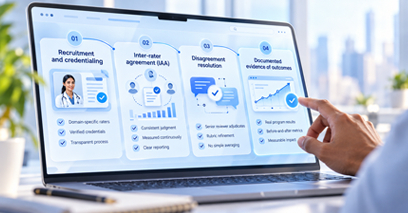
Firstsource defines its own red teaming work in those terms. The job is adversarial probing of a model before and after it ships, jailbreak discovery that finds the specific phrasings and techniques that slip past guardrails, and safety stress-testing across the scenarios a product will actually face. Each of those activities is paired with structured remediation reporting, so the findings arrive classified and ready to act on rather than as a narrative write-up. That pairing, adversarial testing on one side and structured, retrain-ready output on the other, is what defines the data-services category and separates it from a tool that simply flags vulnerabilities.
Why enterprises are outsourcing this work now
Two pressures are pushing adversarial testing from a nice-to-have into a standing requirement. The first is how fragile frontier models turn out to be once you attack them deliberately. Adversarial robustness research published on arXiv found that 68% of frontier models tested show significant performance degradation under structured adversarial attack compared with their scores on standard benchmarks. A model that looks safe and capable on a public leaderboard can behave very differently when a skilled tester is actively trying to break it. That gap is exactly what a red teaming program exists to find, and it is not something a one-time benchmark run will surface.
The second pressure is regulatory. Article 9 of the EU AI Act requires high-risk AI systems to demonstrate adversarial testing and robustness evaluation before deployment. Teams should reconfirm the precise obligations against the current text of the Act with their own compliance counsel before relying on them, because the implementing detail is still settling. But the direction is clear enough to plan around: for systems that fall into the high-risk category, documented red teaming is becoming a condition of shipping, not just a best practice someone can defer.
Put those two together and the case for outsourcing gets easier to make. Building the capability in-house means hiring domain testers who understand how failures show up in finance, healthcare, or legal contexts, finding native speakers across dozens of languages, and keeping the whole operation running continuously as models and attacks evolve. That is slow to stand up and expensive to maintain. An established provider already has the testers, the language coverage, and the operating rhythm in place, which is why more model teams are treating this as work to buy rather than build.
What to evaluate when comparing providers
Once you decide to bring in a provider, the conversation gets easier if you anchor it to a few concrete criteria. These four come up in almost every serious buyer evaluation, and each one maps to a question you can ask a vendor directly.
Domain specialist coverage
Industry-specific jailbreaks are the ones generalist testers tend to miss. A tester who understands financial services knows how a fraud request can be reframed to sound legitimate, and will probe for it. A tester with a clinical background knows which phrasings coax a model into giving dangerous medical advice, and will chase those. A generalist working from a standard attack list often will not think to try either, because the risky pattern depends on knowing the domain. So the first thing to ask is who the testers are and what they know, not just how many of them there are.
Language and geographic reach
Jailbreak techniques are frequently language- and culture-specific. A prompt that a model refuses in English may succeed when it is rephrased in another language, encoded in a local idiom, or wrapped in a cultural reference the model's safety training never saw. If you test only in English, you are checking a fraction of the attack surface for a product that ships globally. The question here is how many languages a provider can cover with native speakers, and across how many regions, because the failure modes you care about may only appear in the markets you are about to enter.
Attack-method depth and documentation
A credible provider can name its attack methods and tell you how they are categorized. That means being able to walk through prompt injection, persona manipulation, encoding attacks, multi-turn escalation, and multimodal injection as distinct techniques, each with its own purpose, rather than describing the work as "trying to break the model." When a vendor can enumerate and document its methods, you can reason about coverage and spot gaps. When the description stays vague, you have no way to know what the program actually tested.
Remediation output format
The last criterion is what you get back. A narrative PDF that reads like a consulting report tells you something went wrong, but it leaves your model team to translate prose into training data by hand. A structured output does that work for you: findings classified by severity and attack type, with the prompt-and-response pairs documented in a format that drops into an RLHF or fine-tuning pipeline. The difference shows up in how fast you can close the loop between discovering a failure and retraining against it.
How the data-services provider set compares
Several vendors operate in this category, and it helps to know what each is generally recognized for before narrowing a shortlist. Surge AI is known for high-quality human data work and RLHF-oriented labeling. iMerit, now part of EXL, has a long track record in data annotation and human-in-the-loop services across industries. SuperAnnotate is recognized for its annotation platform and tooling for managing labeling workflows. Innodata offers data engineering and annotation services at enterprise scale. All four are real options, and the right choice depends on how your needs line up against the four criteria above.
Firstsource sits in the same category and differentiates on named, documented capability rather than general positioning. Its red teaming programs run 18+ documented adversarial attack methods, cover 50+ languages in adversarial testing, and draw on a testing workforce represented across 100+ countries. Those numbers come with a result to match: on a financial services chatbot program, Firstsource reported 99.3% PII recall and a 98.7% prompt-injection block rate. The point of citing specific figures is to give buyers something to score against. Any vendor you consider should be able to answer the same questions with numbers of its own.
Inside Firstsource's red teaming methodology
Firstsource structures its red teaming as four phases that span a model’s lifecycle, so that testing continues after launch instead of stopping at it.
The first phase is pre-deployment probing. Before a model ships, domain specialists run structured adversarial campaigns mapped to the product’s threat model. They probe for policy violations, harmful outputs, and jailbreaks across categories such as toxicity, bias, PII, and misinformation.
The second phase is jailbreak discovery. Here the work narrows to the techniques that get past guardrails: prompt injection, role-play setups, encoding attacks, and multi-turn conversations that gradually walk a model toward an output it should refuse. Each pattern is cataloged, reproduced, triaged by severity, and documented as prompt-response pairs.
The third phase is multimodal attack generation. Because many products accept more than text, testers generate synthetic adversarial assets across image, audio, and video using FluxAI, RealVisXL, StyleGAN3, and SD 3.5L. The resulting asset libraries cover 18+ attack methods, including multimodal asset injection, which extends red teaming beyond the text channel into the places real attackers will push.
The fourth phase is continuous adversarial monitoring. Models change, new attack techniques appear, and a guardrail that held last quarter may not hold today. In this phase Firstsource runs ongoing red teaming against deployed models, harvesting edge cases and detecting retraining triggers that feed back into safety pipelines. The practical effect is that red teaming becomes a standing function that tracks a model across its life instead of a gate it passes once.
Firstsource’s global red teaming workforce spans 100+ countries and covers 50+ languages, with native-speaker testers probing for culture-specific failure modes that English-only testing misses. The Firstsource Gigsourcing Platform provides the talent network behind it. Findings arrive as structured safety reports that classify failures by severity, attack type, and model version. Each report includes prompt-response pair documentation ready for RLHF integration and is structured for EU AI Act Article 9 and NIST AI RMF compliance.
Proof points from production programs
The clearest way to judge a methodology is by what it produced in a live program. Two Firstsource engagements show the pattern.
On a financial services chatbot program, Firstsource’s testing reached 99.3% PII detection recall and a 98.7% prompt-injection block rate across more than 10,000 adversarial prompts. The PII figure means the safety pipeline caught nearly all of the personally identifiable information in scope, and the block rate means the chatbot’s defenses stopped nearly 99 of every 100 injection attempts during testing. The program covered US, EU, UK, and APAC jurisdictions. A financial services chatbot is a demanding test case, because the model sits close to sensitive customer data and the regulatory exposure around a leak is high, so both the prompt volume and the recall figure matter for buyers weighing a similar deployment. The full results are in the published case study.
The second program was penetration testing for an online marketplace for homestays and experiences, aimed at identity and listing fraud. Firstsource produced more than 10,000 GenAI and non-GenAI image and video assets, including government IDs, verification documents, and property photos and videos, that serve as reproducible penetration-test cases across 18+ attack methods. The client received a reusable library and a playbook for scaling future tests rather than a one-off assessment. Reproducibility is the useful property, because an adversarial case you can run again is one you can use to confirm a fix held. The work is written up in Firstsource’s published penetration-testing case study.
Talk to a red teaming lead
A buyer's comparison framework
The four evaluation criteria from earlier turn into a usable scorecard when you add compliance readiness and weigh all five together. Here is the set to score each vendor against:
- Domain coverage. Do the testers have credentialed expertise in your industry, and can they point to the specific jailbreaks that expertise lets them catch?
- Language and geographic reach. How many languages can they test with native speakers, and do those languages and regions match where your product ships?
- Attack-method count and documentation. Can the provider name and categorize its methods, and give you a count you can compare, the way Firstsource documents 18+ methods?
- Remediation format. Do the findings come back classified by severity and attack type as retrain-ready data, or as a narrative report you have to convert yourself?
- Compliance readiness. Can the provider produce the documentation that regimes like the EU AI Act's Article 9 call for, in a form your compliance team can use?
The reason to weigh all five together, rather than picking a winner on any single one, is that strength in one criterion does not cover weakness in another. A provider with an impressive attack-method count but English-only testing leaves your non-English markets exposed. A provider with broad language reach but narrative-only reporting slows down every retraining cycle. Score each vendor across all five, including Firstsource, and let the full picture decide the shortlist.
How this category differs from security-tool red teaming
It is worth drawing the line clearly one more time, because the overlap in vocabulary causes real confusion during procurement. Security-tool vendors such as Mindgard, CrowdStrike, Lakera, and HiddenLayer test infrastructure and model security surfaces. Their work probes the systems around a model and the ways an attacker might compromise them, and their deliverable is a security findings report aimed at engineering and security teams. That is valuable work, and nothing here argues against it.
Data-services providers test the model's behavior and deliver labeled findings meant for RLHF or fine-tuning. The output is training data, sorted by severity and attack type, that goes to the model team to make the model itself safer. The buyer, the deliverable, and the downstream use are all different.
Plenty of regulated enterprises end up using both, and that is a reasonable position. A bank deploying a customer-facing assistant may want a security vendor checking its infrastructure and a data-services provider stress-testing the model's behavior, because the two cover different risks. The mistake is treating them as interchangeable line items on the same shortlist. When you know which problem you are solving, the category you need becomes obvious, and the comparison framework above applies to the data-services side of that split.
FAQ
What are the best AI red teaming data services providers for LLM safety testing?
Providers active in this category include Firstsource, Surge AI, iMerit (EXL), SuperAnnotate, and Innodata. The strongest options combine domain-specialist human testers, broad language coverage, and remediation output that is ready to feed back into RLHF or fine-tuning. The right pick depends on how each vendor scores against those criteria for your specific product and markets, so treat the names as a starting shortlist rather than a ranking.
What is the difference between an AI red teaming data services provider and a cybersecurity red teaming vendor?
A data services provider tests a model's outputs and generates labeled adversarial datasets meant for retraining, run by domain specialists. A cybersecurity vendor tests infrastructure and model security surfaces, usually with automated tooling, and delivers a security findings report. The two solve different problems, and some regulated enterprises use both because the risks they cover do not overlap.
How many languages should an enterprise adversarial testing program cover?
It depends on where the product ships, but global deployments should look for providers with native-speaker coverage across dozens of languages, since culture-specific failure modes rarely show up in English-only testing. A jailbreak that a model refuses in English can succeed when it is rephrased in another language or wrapped in a local idiom. Firstsource runs multilingual adversarial testing across 50+ languages.
What does "RLHF-ready" red teaming reporting mean?
It means the findings are structured as classified failures, by severity, attack type, and model version, with prompt-and-response pairs documented in a format that can feed directly into reinforcement learning from human feedback or fine-tuning pipelines, rather than a narrative report. The practical payoff is speed: your model team can move from a discovered failure to a retraining signal without first translating prose into data by hand.
Is red teaming required for EU AI Act compliance?
Article 9 of the EU AI Act requires high-risk AI systems to demonstrate adversarial testing and robustness evaluation before deployment, which makes documented red teaming a compliance requirement for systems that fall into that risk category. The exact obligations are still being clarified in the Act's implementing detail, so confirm the current requirements with your own compliance counsel before relying on them for a shipping decision.